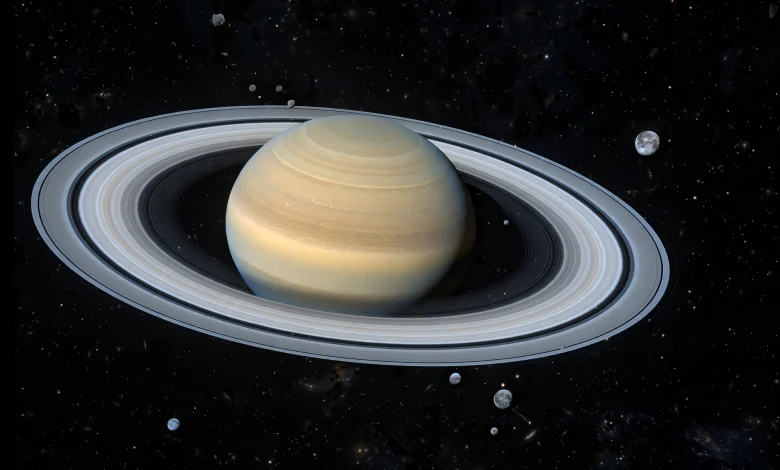
Saturn has pulled decisively ahead in the solar system’s moon contest, and for techmarsh.com readers the story is as much about the tools as the tally. Astronomers have confirmed 128 new moons, taking the planet’s total to 274, more than all the other planets combined, and nearly double Saturn’s previous count of 146. The moons are small and far away, which is exactly why they hid for so long, and why a survey built on patience and image processing has changed a number that many people assumed was settled.
A Record That Rewrites the League Table
For years the contest between Saturn and Jupiter was close enough to follow like a scoreboard. That closeness has now ended. Before this announcement Saturn stood at 146 confirmed moons; adding 128 in one go lifts the figure to 274, greater than the confirmed totals for every other planet put together. Technology made the difference. Modern detectors record objects so faint that earlier surveys missed them, and software combines many exposures into a usable signal. Readers who follow our coverage of artificial intelligence reshaping the web will recognise the pattern: better tools reveal a reality that was always there, waiting to be measured properly.
How Shift and Stack Finds the Almost Invisible
The survey relied on the Canada-France-Hawaii Telescope on Mauna Kea and on a method called shift and stack. Researchers gathered deep images over several years, then shifted each frame to follow the slow drift expected for a distant Saturn moon before stacking them together. A genuine moon brightens into a point; background stars smear away. Follow-up observations tracked each candidate long enough to calculate an orbit. Only after that work did the International Astronomical Union recognise the objects, turning candidates into officially counted moons rather than interesting smudges on a screen.
Tiny, Tilted and Travelling Backwards
None of the newcomers resembles Titan or Enceladus. Most measure only a few kilometres across, and they circle Saturn far from the bright rings, on paths tilted sharply against the planet’s equator. Many move retrograde, opposite to Saturn’s rotation. Those odd orbits are a clue to their history. Astronomers think such moons were not born beside Saturn at all. Instead they were likely captured, then broken apart. Teams including Dr Edward Ashton at the University of British Columbia argue that clusters of similar fragments point back to larger parent bodies shattered in collisions.
Why Fragments Matter to Planetary Science
A pile of fragments may sound like debris, yet debris carries a record. If several small moons share nearly identical orbits, they probably split from one object at a measurable moment in the past. Dating those breakups helps researchers reconstruct how crowded the outer solar system once was, and how often passing bodies were captured, collided or ejected. Saturn, with its strong gravity and wide retinue, becomes a natural archive. Each new fragment adds a data point, and 128 data points at once can change which models of planet formation still fit the evidence and which need to be discarded or substantially revised.
What Happens Next for the New Moons
Recognition is not the final step. The new moons will receive designations, their orbits will be refined, and some may eventually be named under traditions already used for Saturn’s irregular groups. More surveys are certain to follow, because this result proves how much remains hidden at the edge of detection. Our earlier report on a SpaceX dawn launch painting the sky showed how quickly a space story can capture attention; this one is quieter, but its scientific effect lasts longer. Saturn’s total may rise again, yet for now 274 is the number every textbook, app and planetarium programme needs to update.
One More Point of Context
For casual observers, the most surprising part may be that so many moons escaped notice while amateur telescopes were imaging Saturn every clear season. The answer is scale and contrast. Saturn is bright, its new moons are exceedingly faint and far from the planet, and a single exposure strong enough to show them is also full of stars and artefacts. Only a survey designed for this exact problem, returning to the same fields over several years and processing the images as a set, could separate genuine companions from the background with the confidence official recognition requires.