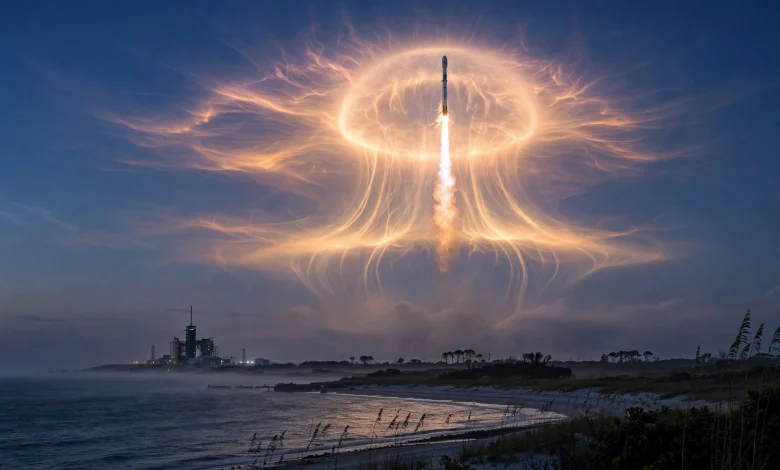
Early risers along the US east coast were treated to an extraordinary sight this week when a SpaceX rocket climbing through the pre-dawn sky left behind a vast, glowing shape that witnesses quickly compared to a jellyfish drifting through the stars. Photographs shared from Florida to the Carolinas showed a luminous blue-white plume expanding high above the Atlantic, its rounded head trailing long, delicate tendrils of light. The spectacle, reported by The Guardian, stopped commuters in their tracks and lit up social media within minutes of the launch.
It was not a cloud in the ordinary sense, and it was certainly not anything unidentified. It was the exhaust plume of a rocket, caught at exactly the right moment, at exactly the right altitude, by sunlight that had not yet reached the ground below. Scientists call the effect a twilight phenomenon, and while launch providers and space agencies have explained it for years, few explanations prepare people for how strange and beautiful it looks in person.
Why the Plume Glows Like a Jellyfish
The shape begins with expansion. Near the ground, a rocket engine’s exhaust is held in a tight, bright column by the pressure of the surrounding air. As the vehicle climbs into the thinner upper atmosphere, that pressure falls away. The exhaust is then free to spread outward in every direction, billowing into a wide, translucent bubble rather than a narrow jet. Seen from hundreds of miles away, that bubble becomes the rounded bell of the jellyfish, while streams of vapour and ice crystals trailing behind the rocket form its tentacles.
The glow comes from timing. The launch took place while the ground below was still in darkness, but the plume, tens of miles overhead, was already in full sunlight. Sunlight scattered through the expanding exhaust and the tiny ice crystals within it, producing the soft blue, white and faintly pink colours visible in photographs. Observers on the ground were looking up from shadow at an object already lit by day, which is why the cloud appeared to shine against a dark sky rather than fade into it.
Water vapour plays a central role. Rocket exhaust is largely steam, and in the cold of the upper atmosphere that steam freezes almost instantly into a cloud of microscopic ice. Those crystals are excellent at catching and scattering light. As winds at different altitudes move at different speeds, the cloud is stretched and twisted, which explains why some images show a neat, symmetrical dome while others show a plume pulled into long, curling ribbons.
A Familiar Effect, Seen at Its Best
SpaceX launches from Florida have produced similar displays before, and evening and early morning missions from California have created comparable spectacles over the western United States. What made this event stand out was the combination of clear skies along much of the coast, a launch window close to sunrise and the sheer distance over which the plume remained visible. Because the effect happens so high in the atmosphere, it is not limited to people near the launch pad. Anyone with a clear view of the sky, sometimes several states away, can see it.
Agencies such as NASA have long documented twilight phenomena from rockets and missile tests, noting that the displays can occasionally prompt calls from concerned members of the public. That reaction is understandable. The cloud expands silently, changes shape over several minutes and can appear to hang in the sky long after the rocket itself, by then a fast-moving point of light, has disappeared over the horizon.
For readers catching up with the latest science and technology coverage, more reporting is available on the TechMarsh homepage, where the day’s top stories are updated throughout the day.
When Are You Most Likely to See One?
The best viewing window is narrow and predictable. Launches roughly 30 to 60 minutes before sunrise or after sunset offer the ideal geometry, because the ground is dark enough for contrast while the upper atmosphere is already, or still, sunlit. Launches in the middle of the night usually produce a bright but compact plume, while daytime launches wash the effect out almost completely against a bright sky.
Clear, dry air helps enormously. Low cloud will hide the display entirely, and haze near the horizon dulls its colours. Elevation helps too, as does a view toward the launch site with few buildings or trees in the way. Photographers who have captured previous jellyfish clouds recommend arriving early, letting your eyes adjust to the dark, and using a phone or camera capable of long exposures, which reveal colours and structure the naked eye can easily miss.
More Launches, More Chances to Look Up
With launch cadences from Florida’s space coast continuing to rise, these dawn spectacles are becoming a recurring feature of east coast skies rather than a once-in-a-decade curiosity. Each one is a reminder of something easy to forget in an age of routine orbital flight: a rocket does not simply vanish into space. For a few minutes, under the right light, it paints its path across the sky in ice and sunlight, large enough for millions of people to see at once.
The next time an early launch is scheduled, it may be worth setting an alarm. The rocket itself will be gone in moments. The jellyfish, glowing quietly above a sleeping coastline, tends to linger a little longer.