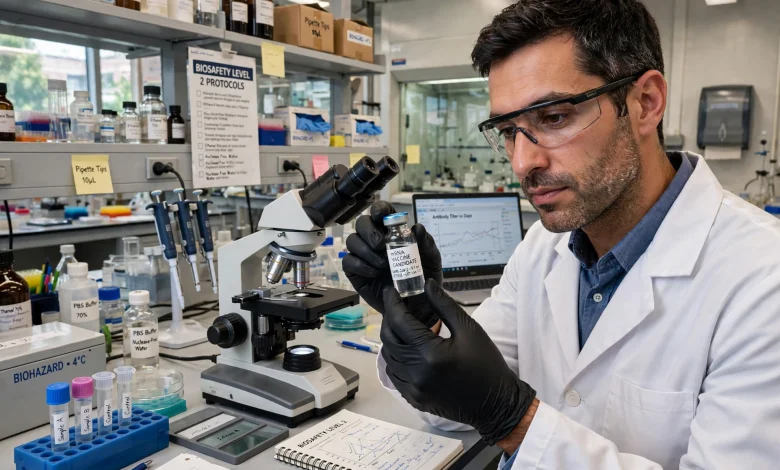
A vaccine designed for exactly one patient at a time has passed an early practical test, and techmarsh.com readers should understand both what that means and what it does not. NeoVax, a personalised neoantigen vaccine built from each patient’s own tumour mutations, was combined with nivolumab in a phase 1 trial in platinum-sensitive recurrent ovarian cancer. The study, published in Nature Medicine, found that such vaccines could be manufactured and administered, that safety was acceptable, and that immune responses were seen. It did not test, and does not claim, a cure.
Built From the Patient, Not From a Shelf
NeoVax is not a standard jab made in bulk. It is a personalised neoantigen vaccine, designed from the mutations found in one patient’s own tumour. Neoantigens are protein fragments created by those mutations, which makes them visible to the immune system as unfamiliar. In a phase 1 trial in platinum-sensitive recurrent ovarian cancer, reported in Nature Medicine, NeoVax was combined with nivolumab, a PD-1 immune checkpoint inhibitor. The technology question is central for our readers: could a bespoke vaccine be manufactured reliably, delivered on schedule, and paired safely with an existing immunotherapy? Our coverage of AI’s wider effects on the web shows how new platforms promise much; trials like this test whether a platform works in practice.
Feasibility Was the Primary Question
Phase 1 trials are designed first to test safety and practicality, not to prove that a treatment works. On that limited question, the study reported encouraging operational results: vaccines could be manufactured from patients’ tumour material and administered as planned, alongside nivolumab. Safety was described as acceptable within the trial’s early context. That wording matters. It does not mean risk-free, and it does not establish benefit. It means the approach cleared the first hurdle every personalised therapy faces, actually reaching patients in a controlled setting without a safety signal that would stop development at this stage. Larger, controlled studies would be needed to judge any clinical effect.
Immune Responses Were Observed
Researchers also looked for biological activity, and they reported T-cell responses linked to the vaccine approach. In plain terms, immune cells from treated patients showed responses consistent with recognising targeted neoantigens. That is a meaningful scientific signal, because a cancer vaccine that produces no immune response has little reason to proceed. It is not, however, the same as showing tumours shrink, recurrence is delayed, or lives are extended. Those outcomes require bigger trials with comparison groups and longer follow-up. Information from the National Cancer Institute explains why early immunotherapy findings are framed cautiously: immune activity is a step on the path, not the destination.
Why Ovarian Cancer Is a Difficult Test Case
Recurrent ovarian cancer that remains platinum-sensitive is a serious, complex setting. Patients have already received chemotherapy, their disease has returned, and treatment choices carry real trade-offs. Testing a personalised vaccine here is demanding because tumours differ between patients, manufacturing takes time, and the immune system may have been affected by earlier therapy. That the trial, published in Nature, could complete manufacturing and administration in this population supports feasibility in a hard context, while also underlining why results from a small group cannot be generalised to everyone with ovarian cancer without further evidence.
What Readers Should Take Away, Carefully
The balanced summary is this: a personalised vaccine made from a patient’s own tumour mutations could be produced and given with nivolumab in a small phase 1 study; safety was acceptable; and T-cell responses were seen. Nothing stronger is justified yet. There are no cure claims to make and no efficacy conclusions to draw. If later trials confirm benefit, the manufacturing and logistics proven here will matter enormously, because personalised treatment only helps patients if it can be delivered reliably and in time. For now, this is promising early science, reported as such, and few stories reward careful wording more than early cancer research, as our recent space launch coverage audience will appreciate.
One More Point of Context
Trial literacy matters here because ovarian cancer patients and their families often encounter early results through headlines stripped of context. A responsible account should therefore repeat the essentials wherever the story is summarised: this was a phase 1 study, it involved a specific group whose cancer had returned but remained platinum-sensitive, and its positive findings were about feasibility, acceptable safety and immune response. None of those findings, alone or together, establishes that NeoVax helps patients, and presenting them as if they did would be a disservice to the very people the research hopes to serve.