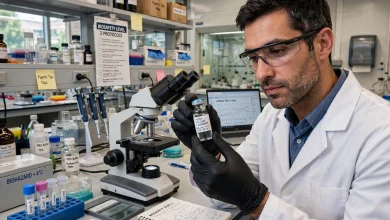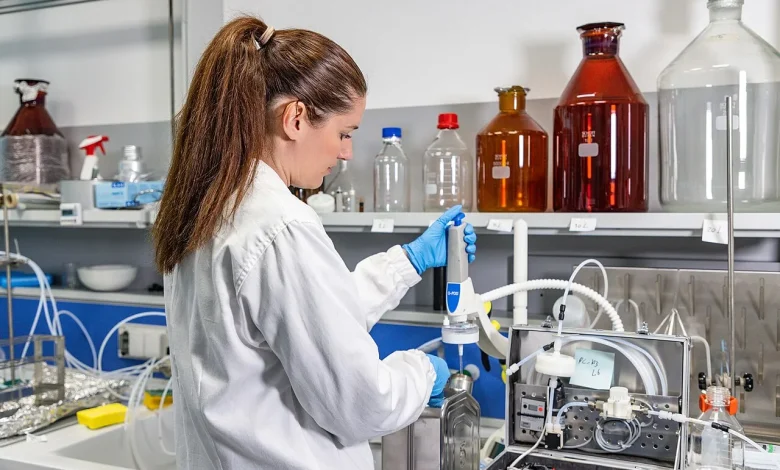
Every microplastics headline rests on an unglamorous craft: persuading a litre of water to reveal particles thousands of times smaller than a grain of sand, without accidentally counting the laboratory itself. Our health coverage steps inside that craft — the sampling, filtering, spectroscopy and blank-checking that stand between a bottle of water and a published number.
The topic matters because the numbers travel: a survey of 15,000 people in 81 countries shows bottled-water habits holding firm despite microplastics awareness, and public debate quotes particle counts as if they were temperatures. They are not. They are the product of choices, and understanding the choices is understanding the result.
From bottle to filter
A typical study begins by emptying samples through fine filters that trap particles above a chosen size — the first and most consequential choice, because everything smaller passes through uncounted. What the filter catches is then examined: visually under microscopes for larger fragments, and with infrared or Raman spectroscopy for chemical identification, since a particle that looks like plastic is not always plastic, and cotton fibres impersonate synthetics cheerfully.
Each technique has a floor. Microscopes miss the tiny; spectroscopy is slow and expensive per particle; newer laser-based methods count far smaller particles far faster, which is why recent studies report counts orders of magnitude higher than older ones. The water did not change. The ruler did.
The enemy in the room
Ask microplastics researchers about their nemesis and they will describe their own clothing. Indoor air carries synthetic fibres; samples left uncovered collect them; plastic equipment sheds them. Serious laboratories work in cleaned-air cabinets, wear natural fibres, rinse everything in filtered water, and run ‘blanks’ — empty samples processed identically — to measure and subtract their own contamination.
The World Health Organization’s drinking-water assessments have highlighted this quality problem in calling for standardised methods: until blanks, size ranges and reporting units are uniform, the literature’s spread of results says as much about laboratories as about water.
What a count can and cannot say
A final number — particles per litre — compresses all those choices into one figure. It can support comparisons within the same study: this brand against that one, bottled against tap, before against after a process change. It cannot, by itself, support a health claim, because counts are not doses of harm: particle size, shape, chemistry and the body’s handling of each all intervene between a count and a consequence.
That is why careful papers end with methods sections longer than their conclusions, and why the honest translation of any count is ‘under these methods, in this size range, we found this many’. The compression that headlines perform removes exactly the words that make the finding true.
Better rulers, better answers
The field is converging: reference materials, inter-laboratory comparisons and reporting standards are all in progress, and the nanoplastics frontier — particles a thousand times smaller than the micro range — is acquiring instruments of its own. As rulers improve, expect reported counts to change again, probably upward, without the world having changed at all.
For readers, the durable skill is not memorising any count but reading like a metrologist: size range, blanks, method, comparison. Counting what you cannot see is possible — science does it daily — but the counting is part of the finding, and any headline that hides it is selling certainty the laboratory never claimed.
Why the craft deserves respect
It is easy to mock a field whose numbers move as its instruments improve, but the movement is the method working: each generation of measurement reveals how much the previous one missed, and says so in print. That self-correction, tedious as it looks from the headline side, is what separates a measurement tradition from a marketing claim. The next time a particle count is quoted at you — in alarm or in reassurance — remember the filters, the blanks and the clean-air cabinets behind it, and ask to see them. The number is only as good as the craft, and the craft, increasingly, is good.