Vehicle Wraps and Fleet Branding: Materials, Coverage Levels, Lifespan and What It Actually Costs Per Impression

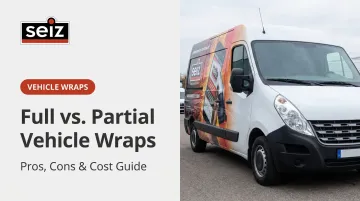
A branded van is the only advertising a company pays for once and then drives past its customers every day for five years. That makes vehicle graphics unusually good value — and unusually easy to get wrong, because the same job done in the wrong material or by the wrong installer looks tired within eighteen months and damages the paint underneath. This article covers what vehicle wrapping actually involves, how the coverage options differ, and how to judge a quote.
Wrap, part-wrap, or lettering
Vehicle graphics come in three broad levels, and the right one depends far more on the vehicle’s role than on budget.
Simple lettering and logo. Cut vinyl letters, a logo and contact details applied to the doors and rear. Cheapest by a wide margin, quick to fit, easy to remove, and entirely adequate for a tradesperson’s van where the goal is a phone number people can read. It leaves the vehicle’s own colour as the background, which means it works best on white and light-coloured vans.
Part-wrap. Printed panels covering perhaps a third to a half of the vehicle — typically the lower body, the rear, and a section of each side — combined with cut vinyl elsewhere. This is the value sweet spot for most fleets: it reads as a designed vehicle from a distance while costing a fraction of a full wrap, and it avoids the most difficult and expensive areas to wrap, such as deep bumper recesses.
Full wrap. Printed vinyl over the entire painted surface, including bumpers, mirrors and door handles. It gives complete design freedom, changes the vehicle’s colour entirely, and protects the original paint underneath. It is also the most labour-intensive by a large margin — a full van wrap is typically two to three days of skilled work — and labour, not material, is the majority of the cost.
A practical rule for a growing business: start with a well-designed part-wrap on the whole fleet rather than a full wrap on one vehicle. Coverage across more vehicles beats depth on one.
Material: this is where wraps fail
Vehicle graphics are the one application where material grade genuinely determines outcome, because vehicles have compound curves, get washed frequently, and sit outdoors permanently.
Cast vinyl is the only correct material for a full or part wrap over curved panels. It is manufactured by casting liquid PVC onto a carrier, producing a very thin, dimensionally stable film with almost no built-in stress. That matters because a vinyl with internal stress will shrink back over months, lifting from recesses and edges. Cast film conforms to compound curves under heat and stays there. Expect a rated life of seven to ten years.
Polymeric calendered vinyl is acceptable for flat and gently curved panels — box van sides, trailer flanks, flat door areas — and is meaningfully cheaper. Rated five to seven years. It should not be used over deep recesses or complex curves; it will lift.
Monomeric vinyl has no place on a vehicle. It shrinks visibly within a year.
Laminate is not optional. A cast overlaminate protects the print from UV, from the mechanical abrasion of brush washes and from fuel splash. An unlaminated printed wrap will fade noticeably within two years, and reds and oranges go first. Gloss laminate is the standard; matte and satin are popular and cost slightly more; textured laminates (brushed metal, carbon) are available for accent panels.
When comparing quotes, ask which film and laminate are specified by name. A quote that names them is from a shop that cares; a quote that says “high quality vinyl” is telling you nothing. Print studios that also handle Lipdukų gamyba and larger vehicle work will normally state the film series on the quote as a matter of course.
Design that works at 30 km/h
A vehicle is read in motion, from an angle, by someone who is also driving. That is a far harder viewing condition than a poster.
Three elements maximum. Company name, what you do, and one contact route. A vehicle carrying a service list, a website, a phone number, two social handles and a QR code communicates nothing, because nothing has room to be large.
Make the phone number enormous. If there is one thing a passer-by should be able to read and remember, it is a single contact route. Digits should be as large as the panel allows.
Design around the vehicle, not on a flat rectangle. Door handles, wheel arches, fuel flaps, window lines and panel gaps all interrupt artwork. A professional wrap design starts from a scaled template of the specific make and model, with those features marked, so text never lands across a handle or disappears into a recess.
Consider the rear separately. The rear of a van is viewed for far longer than the sides — often for minutes in traffic — and by a driver who is stationary. It deserves the clearest message and the biggest phone number.
Mind the windows. Rules on covering windows vary by country and by vehicle class. Perforated one-way vision film is the usual solution where windows can be covered, but the driver’s field of view is legally protected everywhere. Check local rules before designing over glass.
Preparation and installation
Installation quality determines lifespan more than anything else.
The vehicle must be genuinely clean — washed, then degreased with isopropyl alcohol, with particular attention to the edges, recesses and around handles where wax accumulates. Any wax or polish residue guarantees lifting. New vehicles should ideally have had a few weeks for paint to fully cure, and vehicles with fresh respray work need considerably longer.
Installation happens indoors, at a controlled temperature, typically 18-25 °C. Wrapping outdoors, in cold, or in dust produces a visibly worse result. This is a real practical constraint in a Lithuanian winter, and any shop offering an outdoor winter wrap is cutting a corner that will show.
Good practice includes removing door handles, mirrors, lights and badges rather than cutting around them, and tucking film edges into panel gaps. It is slower, and it is the difference between a wrap that looks painted and one that looks stuck on. Ask whether removal of hardware is included.
After installation, post-heating of recessed areas with a heat gun sets the film’s memory so it does not pull back out of the recess. Skipping this step is the single most common cause of lifting after a few months.
Aftercare
- Wait 72 hours before the first wash.
- Hand wash where possible. Brush car washes abrade laminate and catch edges. If using an automatic wash, choose touchless.
- Pressure washers: keep below 100 bar, keep the nozzle at least 40 cm away, and never aim directly at an edge or seam.
- Remove fuel spills, bird droppings and tree sap promptly — these etch laminate given time.
- Avoid solvent cleaners and abrasive polish.
- Park under cover where practical. UV exposure is the main ageing factor, and a vehicle garaged overnight will outlast one parked in the open by a noticeable margin.
Removal
A properly installed wrap in cast vinyl comes off cleanly with heat, and the paint beneath is generally in better condition than the surrounding exposed paint because it has been shielded from UV and stone chips. That is a genuine benefit for leased vehicles and for resale.
A wrap left far beyond its rated life becomes brittle and comes off in small pieces, turning a two-hour job into a full day. If the fleet operates on a five-year cycle, plan removal or replacement at year five rather than running the film to failure.
What it costs, expressed usefully
Rather than comparing a wrap to a leaflet run, compare it to any other advertising on a cost-per-impression basis. A van doing normal urban business mileage is seen by a large number of people every working day, over several years, for a single up-front cost and no recurring media spend. Industry estimates of daily impressions for a commercial vehicle in urban use run into the thousands; even taking a conservative view, the arithmetic over a five-year film life is very favourable compared with almost any paid channel.
The practical implication is that skimping on material or installation to save a modest amount is poor economics — a wrap that lasts three years instead of seven has effectively doubled its cost per year. Where the saving genuinely belongs is in coverage level: a well-designed part-wrap in proper cast film beats a full wrap in cheap material every time.
Getting a comparable quote
Ask every supplier for: the film and laminate by manufacturer and series; the coverage level in plain terms, with a diagram; whether hardware removal is included; where and at what temperature the work is done; the warranty on material and on installation separately; and the expected removal cost at end of life. Those six questions turn three incomparable prices into a real comparison.
Also ask to see completed vehicles — not photographs taken on the day of installation, but a vehicle that has been on the road for two or three years. Edges, recesses and colour on an aged vehicle tell you everything a portfolio shot cannot. Studios such as Printobella that handle both design and application can usually point to local vehicles you can go and look at, which is worth more than any brochure.
Summary
- Part-wrap across a fleet usually beats a full wrap on one vehicle.
- Cast vinyl for curves, polymeric for flat panels, never monomeric; laminate is mandatory.
- Three design elements maximum; make the phone number enormous; design on a model-specific template.
- The rear panel gets the most viewing time — treat it as the primary surface.
- Clean, degrease, install indoors at 18-25 °C, remove hardware, and post-heat recesses.
- Hand wash after 72 hours; keep pressure washers away from edges; plan removal at end of rated life.