Automated Assembly Systems: Manufacturing Compliance Solutions for the Aerospace Industry
In aerospace, the compliance challenge is more than just building to spec. You must be able to prove that every torque, placement, and dimension meets exacting standards.
Regulators don’t accept assurances; they demand verifiable records showing that each fastener, weld, and panel was produced within strict tolerances. Manual documentation falls short under that level of scrutiny. Automated assembly systems close this gap by embedding manufacturing compliance into the process itself.
The cost of failing to meet these standards is steep. The FAA recently proposed a $3.1 million fine against one major aerospace manufacturer for “hundreds of quality system violations.” For an industry where reputations and contracts rest on trust, compliance is a mandate.
The Compliance Challenge in Aerospace Assembly
Compared to automotive production, aerospace manufacturing operates at a different scale and pace. Aircraft programs are characterized by low-volume, high-mix production where each build might involve millions of parts sourced from tens of thousands of suppliers. Compliance cannot be an afterthought when so much variation and risk is built into the supply chain.
Certification requirements from agencies such as the FAA, EASA, and ICAO mandate that components meet precise dimensional accuracy and that the processes used to build them are controlled and documented.
Noncompliance carries severe consequences:
- Programs can be delayed.
- Flights might be grounded.
- Trust with regulators, agencies, and customers can erode.
- Fines and penalties can be assessed.
- Legal liability and lawsuits can increase.
You simply must engineer manufacturing compliance directly into your automated assembly systems.
Automated Assembly Systems Enable Manufacturing Compliance
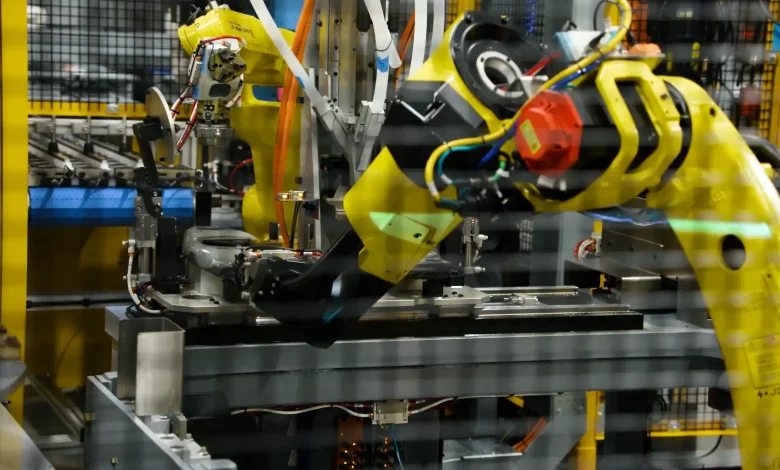
Automated assembly systems combine sensors, robotics, and integrated process control systems to monitor and manage each step in the manufacturing process, optimizing operations and validating compliance.
Key components include:
- Real-time monitoring: Every torque, force, and placement is measured against preset tolerances. Deviations trigger alarms or automatic adjustments before nonconformance occurs.
- Closed-loop feedback: Systems continuously adjust parameters to compensate for variation in materials, tooling wear, and environmental conditions.
- Automated data collection: Instead of handwritten logs, data is captured digitally and stored in compliance-ready databases.
- Integration with MES/SCADA: Plant-floor information feeds directly into enterprise compliance systems, making certification reporting seamless.
By embedding manufacturing compliance into your process, you eliminate having to rely on spot inspections after-the-fact and manual record keeping. Instead, compliance recordkeeping is automatic.
Machine Safety as a Compliance Imperative
Compliance in aerospace extends beyond the finished process to the manufacturing system itself. Regulators demand assurance that assembly processes are precise and safe. To be compliant, automated assembly systems must also take machine safety into account.
Standards such as ISO 13849, IEC 61508, and OSHA requirements dictate how safety circuits, interlocks, and emergency stops must be engineered. In aerospace applications where robotic riveting and large fuselage panel handling create high-risk environments, these safeguards are mission critical.
Control panel design is key here. Safety PLCs continuously monitor conditions, preventing operations from proceeding if doors are open, machine guards are bypassed, or safety thresholds are exceeded. In practice, this means a robotic fastening system assembling fuselage panels won’t initiate a cycle unless all interlocks confirm safe conditions.
These protections ensure safer operation and become part of demonstrating that aerospace manufacturing systems comply with regulations for machine safety.
Bridging Automation, Safety, and Regulatory Standards
What makes aerospace different from many industries is the need for a digital thread. Every part, every process step, and every compliance checkpoint must connect seamlessly, from raw material certifications through final assembly.
Automated assembly systems, combined with machine safety and compliance features, make this possible.
Through real-time data capture, manufacturers can demonstrate alignment with quality management requirements while maintaining audit-ready records for agency oversight. When regulators request evidence, the digital record will clearly show that the product meets specifications and that manufacturing systems were operated safely and in compliance.
This integration of automation, safety, and compliance dramatically simplifies audits and streamlines validation.
Efficiency, Productivity, Safety, and Compliance in Aerospace Manufacturing
Automated assembly systems are key to operational efficiency and productivity. By embedding compliance into engineering design at every step of your aerospace manufacturing process, you can streamline recordkeeping and improve quality assurance to meet mission-critical tolerances and compliance frameworks.Integrating compliance into automated assembly systems requires specialized expertise in machine control, safety standards, and aerospace regulations. Companies like Pacific Blue Engineering focus on designing custom solutions that address these intersecting requirements from the ground up.