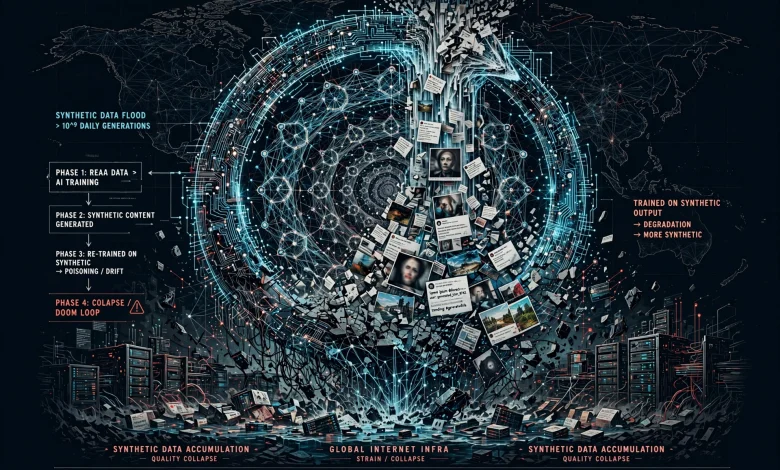
It is the warning the technology industry least wants to hear, not least because it came from inside one of its biggest companies. Internal Microsoft documents, discussed widely in technology forums this week, warned that the company’s own artificial intelligence systems risked starting a “doom loop” — a cycle in which AI-generated content floods the web, future models are trained on that synthetic output, and the quality, diversity and reliability of the open internet steadily collapse.
The phrase is dramatic, but the mechanism behind it is simple, and researchers outside Microsoft have been describing versions of it for several years. The concern is not that AI writes badly. It is that AI now writes, draws, codes and summarises at such scale that its output is becoming a significant share of what the web contains — and therefore a significant share of what the next generation of AI will learn from.
How a Doom Loop Would Actually Work
Modern AI models learn from enormous collections of text and images, much of it gathered from the public web. That web was, until recently, overwhelmingly human: articles, forums, reviews, photographs and arguments produced by people. As generated content pours onto blogs, news sites, product pages and social platforms, the mix changes. A model trained on that new mix is, in part, training on the output of earlier models.
Repeat that cycle enough times and errors compound. The unusual, the original and the minority viewpoint — statistically rare in any dataset — are the first things to disappear, because models favour the most probable patterns. Researchers studying this process, often called model collapse, published findings in Nature showing that models trained recursively on generated data lose information about the real world and drift toward repetitive, degraded output. In plain terms, the copy of a copy of a copy gets worse each time.
The Microsoft documents, as characterised in the discussion, appear to have framed the commercial version of the same risk. If search results, summaries and recommendations are increasingly generated, and if those generations then become the source material for the next round, the web stops being a record of human knowledge and becomes an echo chamber for machines.
Why It Matters Beyond Microsoft
Microsoft is not a bystander in this story. Its search, browser, office software and cloud platforms distribute AI features to hundreds of millions of people, and its partnership with OpenAI places it near the centre of the generative AI boom. A warning from inside such a company carries weight precisely because the company profits from the technology it was cautioning against.
The stakes extend to everyone who publishes or reads online. Independent websites depend on search traffic, and search is rapidly being rebuilt around AI answers. If those answers are trained on an increasingly synthetic web, original reporting and first-hand expertise become harder for models to find and easier for them to dilute. The economics are already visible in debates among publishers about how content is valued, a subject explored in our look at a practical guest posting strategy for early-stage startups, where visibility on the open web remains the currency small sites trade in.
There is also a trust problem. Synthetic content is cheap to produce in bulk, which makes it ideal for spam, fake reviews, fabricated news and influence campaigns. As the volume grows, distinguishing a researched article from a generated imitation becomes harder for readers and for automated systems alike. Watermarking and detection tools exist, but none has yet proved reliable at internet scale.
What Could Break the Loop?
The research consensus, reflected in work from Microsoft Research and other labs, is that the loop is avoidable — but only with deliberate effort. Keeping verified human-created data in training sets, clearly labelling generated material, preserving archives of the pre-AI web and paying for high-quality original sources are all part of the proposed fix. So is restraint: using AI to assist writers and researchers rather than to replace them wholesale with automated content farms.
Some of that is already happening. Dataset curators increasingly filter for provenance, search companies say they reward original reporting, and several AI firms have signed licensing deals with publishers, implicitly admitting that fresh human work has value their models cannot synthesise on their own. Whether those measures keep pace with the sheer volume of generated material being published every day is the open question.
An Internet Worth Training On
The deeper point of the doom loop warning is easy to miss amid arguments about any single company. The web is both a public resource and the foundation on which modern AI is built. Degrade the first, and you eventually degrade the second. An internet filled with content made for algorithms, summarised by algorithms and then fed back to algorithms serves neither readers nor the industry that depends on them.
Microsoft’s documents may have been an internal caution rather than a public prophecy, but the discussion they have provoked is a healthy one. The way out of a doom loop is not less technology. It is more of what made the web worth learning from in the first place: people, writing about real things, for other people to read.