Artificial intelligence is becoming more accessible to small businesses, but choosing the right consultant remains a significant challenge. Many business owners are being approached by firms offering automation tools, AI software, or quick implementation packages without a clear understanding of how those systems fit into day-to-day operations.
For small businesses, successful AI adoption usually depends less on the technology itself and more on how well it supports existing workflows, operational goals, and long-term business processes.
Before hiring an AI consultant, businesses should evaluate whether the consultant understands operational strategy as well as technical implementation.
Look Beyond Tool Demonstrations
Many consultants focus heavily on software features and AI capabilities during initial conversations. While demonstrations can be useful, they do not always reveal whether a consultant understands how businesses actually operate.
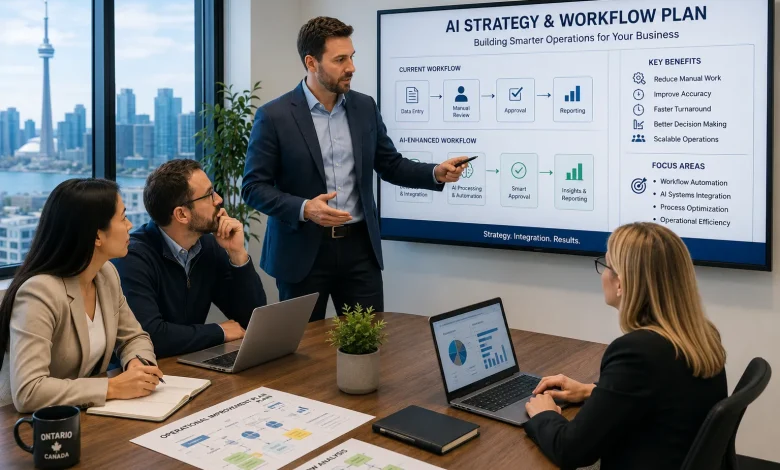
An effective AI consultant for small business environments should begin by evaluating workflows, operational bottlenecks, and process inefficiencies before recommending tools.
For example, if a business struggles with manual reporting, inconsistent customer communication, or disconnected systems, introducing AI software without addressing those underlying issues may create additional complexity instead of improving efficiency.
Business owners should look for consultants who ask operational questions such as:
- How are workflows currently managed?
- Where do delays or repetitive tasks occur?
- Which systems already support the business?
- How do departments share information?
- What operational goals are driving automation efforts?
Consultants who focus first on workflow evaluation are often better positioned to recommend realistic implementation strategies.
Evaluate Their Understanding of Operations
AI implementation is not only a technology project. It is also an operational project that affects employees, communication processes, reporting systems, and workflow accountability.
A consultant may have strong technical knowledge but limited understanding of business process evaluation or operational efficiency. This can lead to disconnected automation efforts that fail to support long-term business goals.
Small businesses should evaluate whether a consultant understands:
- process standardization
- workflow dependencies
- operational risk
- change management
- system compatibility
- implementation planning
This is especially important for companies managing multiple software platforms or manual administrative workflows.
An experienced consultant should be able to explain how operational AI implementation fits into the broader structure of the business rather than presenting AI as a standalone solution.
Businesses should also ask how the consultant approaches workflow documentation, internal communication, and implementation sequencing. These areas are often more important than the software itself during early adoption stages.
Ask About Systems Integration Experience
Many businesses already rely on accounting platforms, customer relationship management systems, scheduling tools, project management software, and reporting applications.
Introducing AI tools without considering existing infrastructure can create fragmented workflows and inconsistent reporting.
A strong consultant should have experience with AI systems integration and understand how automation interacts with operational systems already in use.
Questions worth asking include:
- How will the AI tools connect with existing software?
- Will employees need to duplicate data across systems?
- What reporting changes will occur after implementation?
- How will workflow automation affect customer service or approvals?
- What operational disruptions should be expected during rollout?
Businesses should avoid implementation approaches that rely heavily on temporary workarounds or disconnected applications.
Workflow automation consulting should improve operational visibility and reduce manual complexity over time, not create additional maintenance challenges.
Long-Term Support Matters More Than Quick Deployment
Some consultants focus primarily on short-term implementation projects. While this approach may work for limited software deployments, AI adoption often requires ongoing refinement as workflows evolve.
Businesses should understand what happens after implementation is complete.
For example, will the consultant provide:
- workflow optimization support
- employee training
- reporting adjustments
- automation reviews
- operational troubleshooting
- process refinement recommendations
AI business strategy should be treated as an evolving operational initiative rather than a one-time installation.
Consultants who remain involved after deployment are often better equipped to identify operational inefficiencies, adjust workflows, and improve automation performance over time.
This becomes increasingly important as businesses expand automation into additional departments or operational areas.
Choose Consultants Who Focus on Business Outcomes
One of the most common mistakes businesses make is selecting consultants based entirely on technical language or trending AI tools.
A more reliable approach is evaluating whether the consultant can connect technology decisions to measurable operational outcomes.
An experienced consultant should be able to explain how implementation efforts may support goals such as:
- reducing administrative workload
- improving reporting accuracy
- shortening response times
- increasing workflow visibility
- improving customer communication
- reducing operational bottlenecks
Businesses should also pay attention to whether the consultant discusses realistic implementation timelines and operational limitations. Overpromising rapid transformation often indicates a lack of operational planning experience.
Firms that prioritize workflow architecture and operational alignment tend to provide more sustainable implementation strategies. For example, companies offering structured AI consulting services may focus on workflow analysis, systems integration, and long-term operational planning instead of isolated software deployment. Convex Systems is one example of a consultancy that approaches AI implementation through operational evaluation rather than standalone AI experimentation.
Practical Planning Leads to Better AI Adoption
For small businesses, AI adoption is most effective when it begins with operational clarity instead of technology trends.
The right consultant should help leadership teams understand where automation fits within existing workflows, which processes are ready for improvement, and how implementation decisions may affect employees and operations over time.
Choosing a consultant based on operational understanding, implementation planning, and workflow strategy can help businesses avoid fragmented systems and short-term experimentation.
As AI adoption continues to grow, businesses that prioritize operational readiness and long-term planning will often be in a stronger position to achieve sustainable improvements in efficiency and workflow performance.