Teaching solar energy inside a laboratory has always been a contradiction.
Solar panels live outdoors. They respond to clouds, heat, dust, and shading. Yet most university labs are windowless, controlled spaces where unpredictability is the enemy. For years, educators tried to bridge this gap with halogen lamps or rooftop connections. Both approaches created more problems than they solved.
Halogen lamps overheat panels and distort spectra. Rooftop arrays depend on weather, timing, and luck. You cannot demonstrate partial shading if the sky is clear. You cannot analyse inverter limits when the sun is setting.
This disconnect between theory and practice is why modern energy labs rely on the pv emulator. It brings the electrical behaviour of real solar panels indoors—without depending on the sun.
Why Conventional Power Supplies Fall Short
At first glance, a DC power supply seems adequate for solar experiments. It delivers voltage and current on demand. The problem is how it behaves under load.
A conventional power supply is designed to be stable. Set a voltage, and it fights to maintain it. A solar panel does the opposite. It behaves like a current source with a collapsing voltage once limits are crossed.
A pv emulator is fundamentally different. It continuously calculates the physics of a virtual solar module using validated electrical models. The output updates in real time. When a connected inverter or charge controller draws excessive current, the emulator responds exactly like a real panel would—by allowing voltage to fall sharply.
This behaviour is impossible to replicate with “dumb” lab equipment.
Accurately Reproducing the I–V Curve
Every photovoltaic module has a distinct current–voltage curve. That curve is non-linear, dynamic, and sensitive to operating conditions.
A pv emulator reproduces this curve precisely. As students vary load conditions, they observe voltage sag, current limits, and power collapse exactly as seen in field installations. Because the curve is software-defined, every lab group experiences the same electrical behaviour.
This consistency is critical in academic settings. It ensures learning outcomes are driven by design choices, not weather or timing.
Making the Maximum Power Point a Moving Target
Maximum Power Point Tracking is often taught as a clean control problem. In reality, it is anything but clean.
The power peak shifts continuously with irradiance and temperature. Algorithms overshoot, oscillate, and sometimes lock onto the wrong operating point. A pv emulator exposes these behaviours immediately.
When an MPPT algorithm perturbs voltage, the emulator reacts. Miss the optimal point by even a small margin, and power drops sharply. Students quickly understand that MPPT is not about equations alone. It is about dynamic response and stability.
This lesson is difficult to forget once experienced.
Simulating Temperature Effects Without Waiting for Weather
Heat is one of the most misunderstood variables in solar engineering. Higher temperatures reduce voltage and overall efficiency, even under bright sunlight.
Outdoor demonstrations depend on seasons and chance. A pv emulator removes that dependency. Instructors can define temperature coefficients and simulate thermal drift over time. Voltage degradation becomes visible. Efficiency losses become measurable.
Students stop thinking of temperature as a footnote and start treating it as a design constraint.
Exploring Partial Shading Safely and Repeatedly
Partial shading creates some of the most complex behaviour in photovoltaic systems. Bypass diodes activate. Multiple power peaks appear. Poor MPPT logic can lock onto false maxima and waste significant energy.
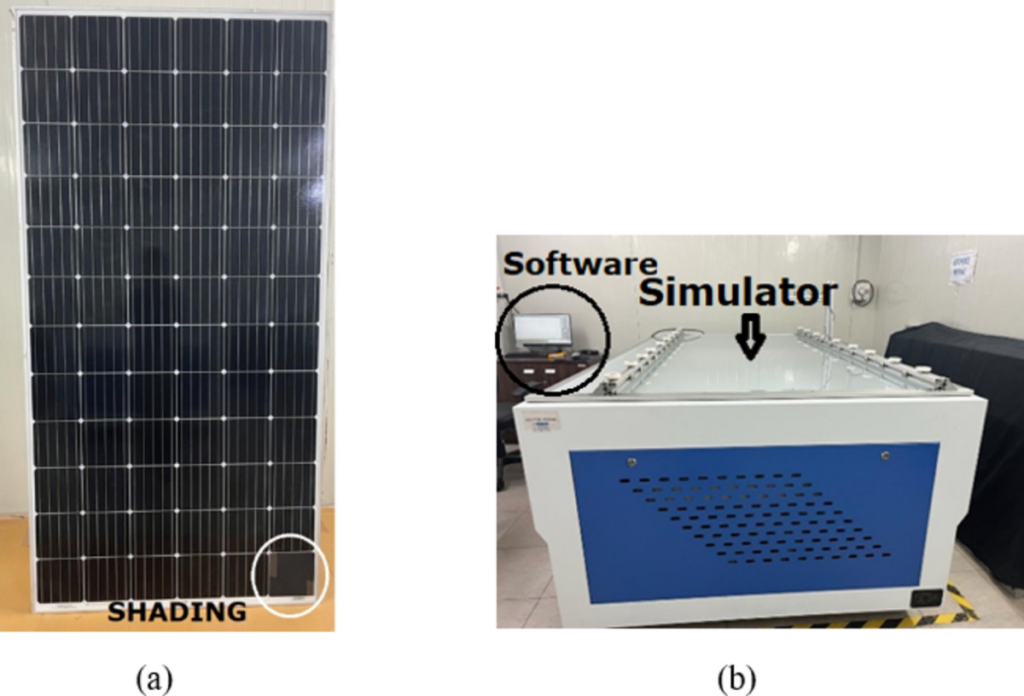
Reproducing these scenarios with real panels is difficult and inconsistent. A pv emulator generates multi-peak I–V curves on demand. Shading patterns can be applied, removed, and modified mid-experiment.
Students can test whether their control logic finds the global maximum or settles prematurely. These experiments reveal design weaknesses long before systems reach the field.
Repeatability That Improves Learning and Assessment
One overlooked advantage of pv emulators is fairness.
When experiments depend on sunlight, results vary between student groups. Differences are often blamed on uncontrollable conditions rather than design errors. This undermines both learning and assessment.
With an emulator, irradiance and temperature remain fixed. If outcomes differ, the cause is clear. This creates a genuinely controlled learning environment and supports meaningful comparison between designs.
Scaling Experiments Beyond Physical Limits
Most universities cannot install large solar arrays. Space, cost, and safety impose hard limits.
Using scaling techniques and hardware-in-the-loop setups, a pv emulator can represent systems far larger than its physical ratings. Researchers can study grid interaction, voltage disturbances, and transient events without building utility-scale infrastructure.
This capability turns teaching labs into serious research platforms.
Closing Perspective
A pv emulator does not replace the sun. It replaces uncertainty.
By reproducing the electrical, thermal, and dynamic behaviour of real photovoltaic systems, it allows students and researchers to engage with solar energy in a controlled yet realistic way. For universities committed to meaningful renewable energy education, the pv emulator is no longer optional equipment. It is foundational.