Autonomous delivery robots are becoming increasingly common in campuses, hospitals, hotels, residential communities, and urban environments. These robots help businesses streamline deliveries, improve operational efficiency, and reduce labor-intensive transportation tasks. As delivery automation continues to expand, robotics companies are deploying larger fleets of autonomous robots to meet growing demand.
While autonomous delivery robots are designed to navigate and operate independently, real-world environments often present unexpected situations that require human assistance. This is why human monitoring plays a critical role in successful autonomous delivery robot operations.
By combining automation with remote human oversight, businesses can improve safety, reliability, and overall delivery performance.
The Growth of Autonomous Delivery Robots
Delivery robots are designed to transport goods from one location to another with minimal human involvement. These robots are commonly used to deliver:
- Food and beverages
- Packages and parcels
- Medical supplies
- Hotel guest items
- Office materials
- Campus deliveries
As organizations seek faster and more cost-effective delivery solutions, autonomous robots have become an attractive option for many industries.
Challenges Faced by Delivery Robots
Although modern robots utilize advanced sensors, cameras, GPS systems, and artificial intelligence, they still encounter situations that can be difficult to handle autonomously.
Common challenges include:
- Unexpected obstacles
- Pedestrian traffic
- Construction zones
- Road closures
- Environmental changes
- Navigation uncertainties
- Sensor limitations
These situations often require human judgment to ensure the robot can continue its mission safely and efficiently.
What Is Human Monitoring?
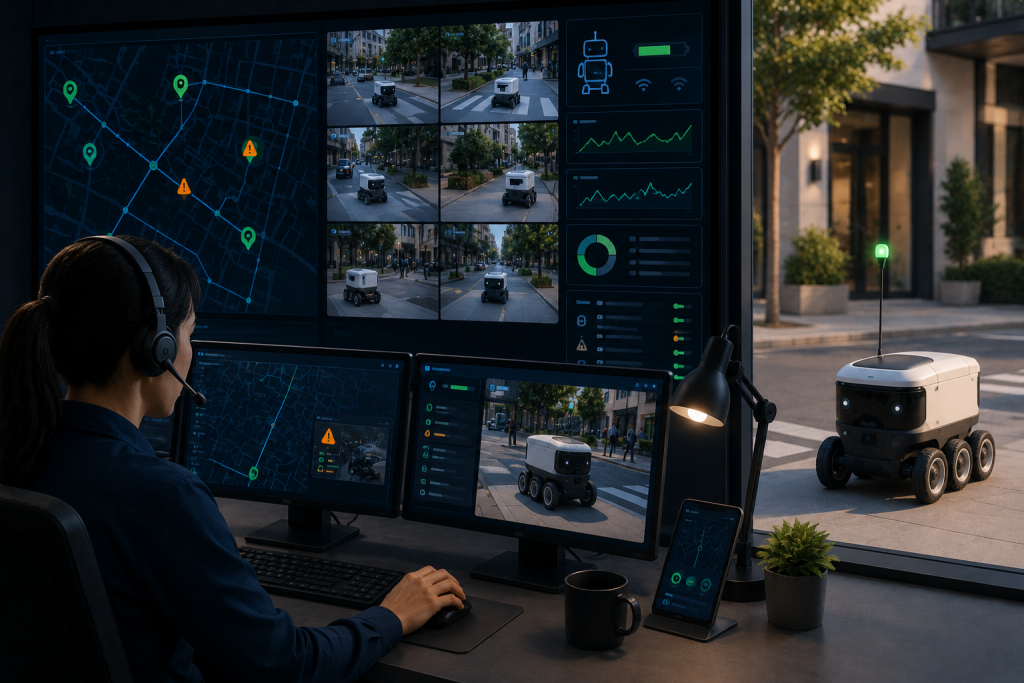
Human monitoring involves trained operators remotely supervising robotic systems through live camera feeds, sensor information, and operational dashboards.
Rather than controlling the robot continuously, operators observe robot activity and intervene only when assistance is required.
Human monitoring may include:
- Reviewing live video feeds
- Monitoring sensor data
- Responding to system alerts
- Assisting with navigation decisions
- Escalating operational issues
- Supporting delivery completion
This human-in-the-loop approach allows robots to operate autonomously while maintaining an additional layer of oversight.
Enhancing Delivery Reliability
Reliability is essential for successful delivery operations. Customers expect deliveries to arrive accurately and on time.
Human monitoring helps improve reliability by allowing operators to:
- Quickly identify operational issues
- Assist robots during navigation challenges
- Resolve exceptions before they cause delays
- Maintain continuous operations
This support helps delivery robots complete their routes more consistently and efficiently.
Improving Safety in Public Environments
Delivery robots often operate in environments shared with pedestrians, vehicles, and other obstacles. Maintaining safe operations is critical for both businesses and the public.
Remote operators help improve safety by:
- Monitoring robot behavior in real time
- Responding to unexpected situations
- Providing assistance when navigation becomes difficult
- Escalating incidents when necessary
Human oversight helps reduce operational risks and supports safer robotic deployments.
Supporting Large Robot Fleets
As robotics companies expand their operations, managing multiple robots simultaneously becomes more complex. Human monitoring services allow operators to supervise large fleets from centralized control centers.
Benefits include:
- Centralized fleet supervision
- Real-time operational visibility
- Faster issue resolution
- Improved scalability
- Better resource management
These capabilities help organizations expand robot deployments without sacrificing reliability.
Reducing Operational Downtime
Robot downtime can disrupt deliveries and impact customer satisfaction. Human monitoring enables operators to identify and address issues before they lead to significant interruptions.
Remote support helps:
- Minimize delivery delays
- Improve robot utilization
- Maintain service continuity
- Increase operational efficiency
Reducing downtime allows organizations to maximize the value of their robotic investments.
Supporting Customer Experience
Customers often judge delivery services based on speed, reliability, and consistency. Human monitoring helps ensure robots provide dependable service experiences by resolving issues quickly and maintaining smooth operations.
Reliable deliveries contribute to:
- Higher customer satisfaction
- Stronger customer trust
- Better brand reputation
- Increased adoption of robotic services
Positive customer experiences are essential for the long-term success of delivery robotics programs.
Why Businesses Invest in Robot Teleoperation & Robot Monitoring
Many robotics companies utilize professional Robot Teleoperation & Robot Monitoring services to provide reliable human oversight for autonomous delivery systems. Dedicated remote operators monitor robot activity, respond to alerts, assist with navigation challenges, and support large-scale robotic deployments across multiple locations.
Professional monitoring services help organizations scale delivery operations while maintaining safety, reliability, and operational efficiency.
The Future of Delivery Robotics
As autonomous delivery technology continues to evolve, human monitoring will remain an important component of successful deployments. While robots can handle many routine tasks independently, human operators provide the flexibility and decision-making capabilities needed to manage complex real-world situations.
The combination of automation and human oversight creates a more reliable and scalable delivery ecosystem.
Conclusion
Human monitoring plays a vital role in autonomous delivery robot operations by improving safety, reliability, efficiency, and customer satisfaction. Through real-time oversight and human-in-the-loop support, organizations can confidently deploy robotic delivery systems in complex environments.
For robotics companies seeking dependable operational support, professional Robot Teleoperation & Robot Monitoring services provide the expertise needed to maintain successful autonomous delivery robot programs and support long-term growth.